
Talent deserves the best opportunities, and access matters just as much as ability. At TU Wien i²c, this belief is reflected in how student entrepreneurship is supported, not only through education, but through concrete pathways into global innovation ecosystems.
As part of the Entrepreneurship Educators Community, TU Wien i²c is part of a global network of leading university-based entrepreneurship centers. The network is deliberately structured to address the needs of different institutional roles, facilitating the sharing of best practices and collaborative problem-solving across institutions. TU Wien is a founding member of GLEEN (Global Leaders of the Entrepreneurship Educators Network), an initiative that builds on MIT’s expertise in innovation-driven entrepreneurship education. GLEEN aims to elevate global standards in entrepreneurship education and to equip future generations of founders to address complex societal challenges. Alongside TU Wien, founding members include the University of Saskatchewan, Georgia National University SEU, Cape Peninsula University of Technology, and the Piauí Institute of Technology – PIT (Investe Piauí).
A central benefit of this collaboration lies in the direct opportunities it creates for students.Through the partnership, TU Wien i²c is able to nominate outstanding students to participate in StartMIT, an intensive 2.5-week entrepreneurship program held each January on the MIT campus. The program brings together selected students from partner institutions and MIT to work side by side in a highly immersive setting, offering a rigorous, hands-on introduction to entrepreneurial thinking, venture creation, and innovation-driven problem solving. Beyond skill development, participants gain early exposure to MIT’s entrepreneurial culture and build lasting networks with peers, mentors, and industry leaders.
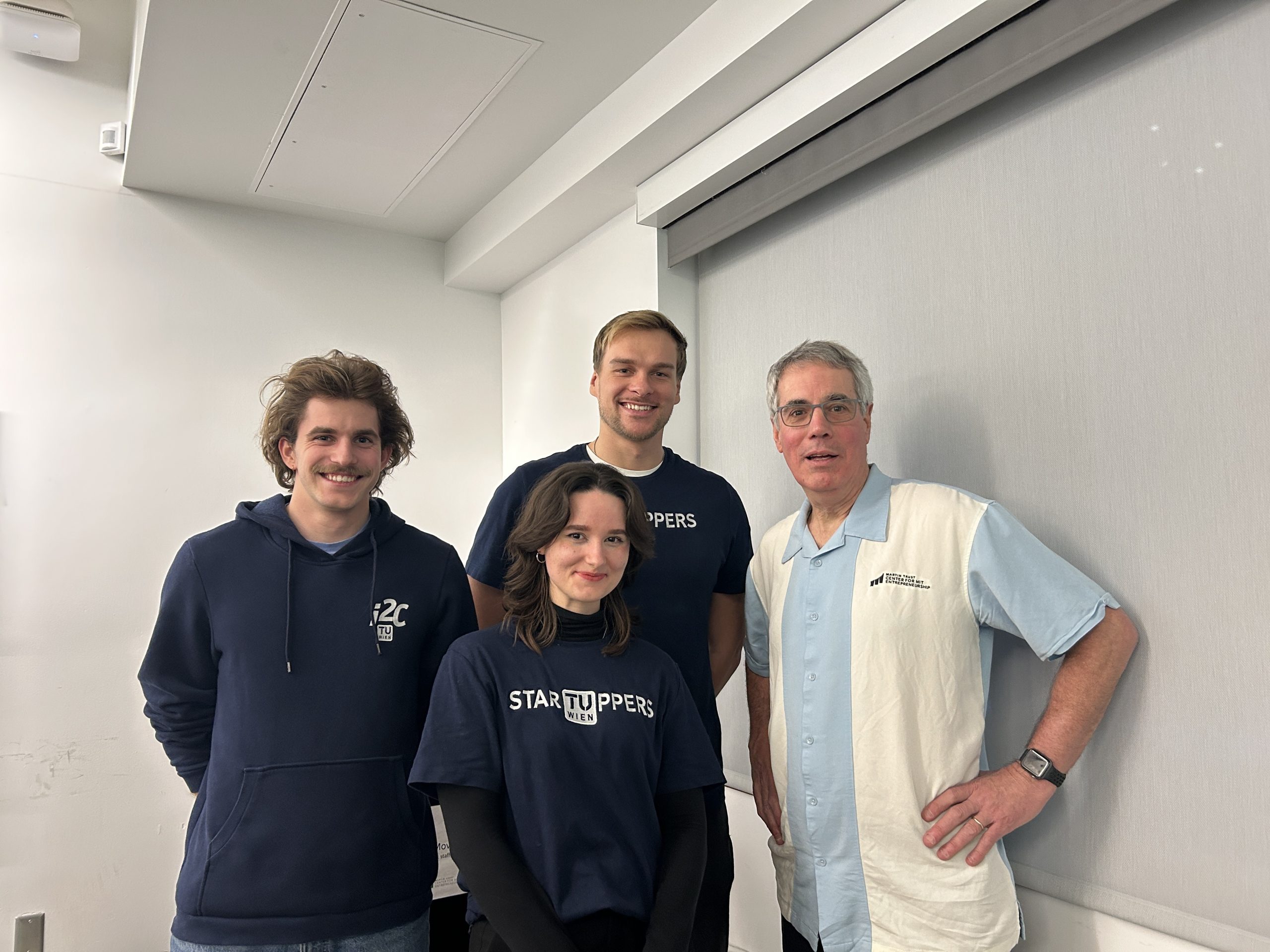
At TU Wien i²c, these global pathways are closely integrated within the perks of the educational programs. Through the Extended Study on Innovation (ESI) program, TU Wien i²c prepares the next generation of innovators through two semesters of hands-on intra- and entrepreneurship education. Wrapped up with a Demo Day and prizes exceeding €250,000, the program enables unique opportunities for outstanding student founders. A recent example is MOBI, the startup founded by Vladimir, Paul, and Ariana, graduates of the program who progressed from idea to startup over the two semesters of ESI.Their work was recognized through several awards. One of these distinctions was the possibility to participate at “StartMIT”. Run by Massachusetts Institute of Technology (MIT), this 2.5 weeks prorgam gives students the skillset and midset required in entrepreneurship. The access was possible due to i2c’s collaboration with MIT.
Experiencing Entrepreneurship at “Scale”For the MOBI team, arriving at MIT meant entering an ecosystem where entrepreneurship operates differently.magnitude. “America is much more profit-oriented,” founder Vladimir reflects. “If it sells, it’s a good idea. The scale of things matters here.”What stood out immediately was the concentration of experience. Encounters with founders who have raised millions, or built billion-dollar companies, are part of everyday life. This density of success stories shifts expectations and expands the perceived limits of what is achievable for young founders.
Learning What Drives MarketsFor Paul, the strongest learning came from the uncompromising focus on customers. Quotes from MIT educators and serial entrepreneurs quickly became guiding principles:“Whoever owns the customer, owns the market.”“Identify your super users, understand why they use you, and then find people just like them.”Entrepreneurship at MIT is framed less as ideation and more as execution under market pressure. This mindset is reinforced through concepts such as the Minimum Viable Business Product, a step beyond the MVP. To qualify, a product must create value, be paid for, and generate feedback. Anything else remains hypothetical.Another defining theme is the pervasive use of artificial intelligence. “You’re not going to lose to AI,” one instructor emphasized. “You’re going to lose to someone who knows how to use AI better than you.” For the MOBI team, this prompted a reassessment of how deeply AI should be integrated into their own business model.
The Special Puzzle PieceImportantly, the MIT experience did not replace prior learning, it contextualized it. Many of the structures and strategies felt familiar. “I see a lot of overlap with what we learned before,” Vladimir notes. “That shows how high the level of the Extended Study on Innovation already is.”This validation matters. It demonstrates that entrepreneurship education developed at TU Wien i²c operates at a level aligned with leading global institutions. By enabling access to these environments, TU Wien i²c extends its educational mission beyond the classroom. When student entrepreneurs have access to world-class ecosystems, learning accelerates and thinking expands.