
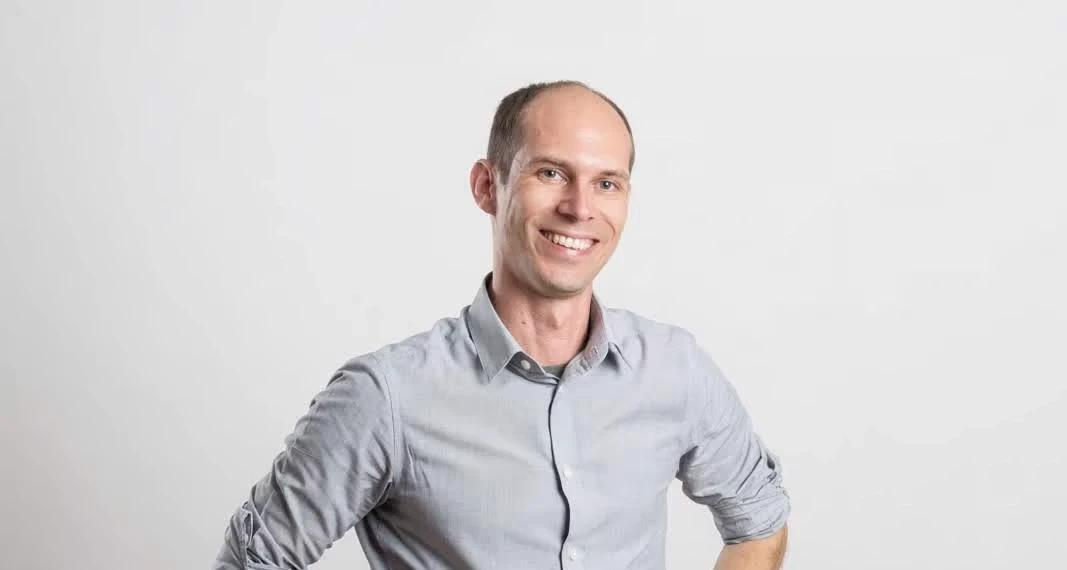
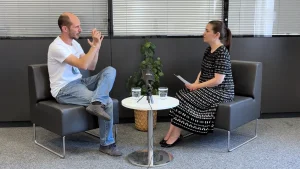
It was a historic moment, not only for contextflow but for TUW i²c as well. For the first time ever, a spin-off from our incubation program has been acquired. To understand the story behind the sale and to learn from this incredible journey, our very own Senior Program Manager Alexandra Negoescu sat down with contextflow Co-founder and CEO Markus Holzer to look back on everything from the early lab days to the deal itself.
Alexandra Negoescu (AN): I’m excited to have you with us today because I think we are closing a cycle, and you’re beginning a new one. I had the pleasure of working with you as the very first project in our very first batch in the TU Wien Incubator. I feel like I’ve known you for a lifetime, because even before that, you participated in our very first STARTacademy as well. Having a lot of firsts together, it’s only natural that we now discuss your success as the first acquisition out of the TUW i²c incubator program. Let me start with the moment it became real, what was the first thing you did once you knew the acquisition was happening?
Markus Holzer (MH): Happy to speak to you as well! A small side note: it’s not yet fully closed. We did the signing a few weeks ago, which is also when the deal was announced publicly. We still require Foreign Direct Investment (FDI) clearance from the Austrian government, which should come through this summer, and then the deal will be fully complete. However, there is no point standing in the way of it going through. But to answer your question…for me, the real moment was the signing. That’s when it became real, and when I allowed myself to start processing it.
The days, weeks, and even hours leading up to signing were incredibly intense, as we were still working out the final details. But once it was done, I basically called the people who were most heavily involved: the core team, the management team and all the people who had supported us throughout the process over the last weeks and months leading to the exit. It was the first time I could call it semi-official. It was a very exciting time, and it started to sink in a bit. Right now, it feels like running and somehow stumbling over the finish line without realizing you’ve already crossed it.
AN: If we take you back to the very beginning, back to 2010, when you started your work as part of the EU research project KHRESMOI, what was the problem that you and your co-founders were obsessed with long before anyone even used the word “startup”?
MH: It was not on anyone’s mind at that stage. I mean, you always think about the success factors of startups and one of them is a bit of luck. Being part of a European research project was quite lucky for me. I was doing my master’s at TU Wien and my master’s thesis at the Medical University of Vienna’s Computation Imaging Research Lab. Coincidentally, a position opened in a European research project because a PhD student had dropped out, and I was asked whether I wanted to pick it up. I had a rough idea of what it was about and said yes; so in addition to my thesis, I started working on this EU research project.
What we were looking at back then was: how can we make use of the large imaging archives stored in hospitals and imaging centers? How can we use machine learning to make that information accessible to physicians, especially radiologists, at the point of care, so that they can ultimately make faster and more accurate diagnoses for their patients? That was the core of the project.
Specifically, what we built was an image search engine that allowed radiologists to find similar cases in their imaging archives, see what had been reported for those cases, and then come up with improved differential diagnoses and reports. We spent four to five years building that research prototype. It was a very exciting time – deep learning hadn’t yet really “arrived”. I think we were also one of the first institutes in Europe to transfer significant amounts of clinical data into the research environment to enable big data analysis.
AN: But you also had to decide what not to build, right? Because you had to choose a specific organ. So why the lung?
MH: That’s true. We started by building a general search engine that could search for anything, MRI or CT, it didn’t matter. Over time we realized the chest is an area where diagnosis is very difficult and where such a system could have a significant impact. That’s why we decided to focus there, because we identified it as having the biggest potential to improve the work of physicians.
AN: I also know that you always wanted your solution to not be a black box. Early in your journey, you wanted radiologists to see how the software reached its conclusions, not just trust the output blindly. Why was that so important to you?
MH: Retrospectively it’s easy to say, that was always a core part of the solution, but actually it was just by design: a search engine is inherently transparent to the user. If you find similar cases, you can show those cases to the physician, and they immediately get a sense of what’s happening in the background. The system says, “these are similar because certain regions in the images have similar visual characteristics.”.’ That ended up having a positive impact as the black-box AI models came onto the market. Unlike the competition, we already had a system in place where you could clearly see what was going on in the background, and that was very important for trust and for regulatory purposes further down the line.
AN: On paper the technology fit looks almost too clean: 4DMedical does functional lung imaging, contextflow does detection. Was that fit clear from the very beginning, or is it more nuanced than that?
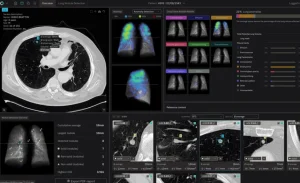
MH: There’s a lot to unpack. To give a bit more detail on what contextflow does: we analyze the structure of the lung (and now also outside the lung) in chest CT scans. We identify image patterns related to lung cancer and lung diseases, and we measure them very precisely: volume, size, everything relevant for a good diagnostic decision. We can extract information that would otherwise be very difficult to get; for example, volume information from 2D images is almost impossible to extract manually, so this is where we add a lot of value. We do this automatically and fast, which speeds up the workflow. We’ve integrated all of this into the radiologist’s clinical routine via existing PACS systems.
What 4DMedical does is complementary: they focus more on functional analysis. It’s not so much about what the pattern is or how much of the lung is affected; rather, their technology looks at how the lung is functioning. Their flagship product analyzes ventilation and perfusion: you take an inhale CT scan, hold your breath, and then take an exhale scan. By comparing those two states, they can map where air flows through the tissue and where blood flows through, essentially mapping where the lung is working and where it isn’t. There is no other company doing this globally. So you have structure analysis on one side and functional analysis on the other, and the two go together very naturally.
Beyond our technology synergies, 4DMedical is a Australia-based publicly-traded company rapidly expanding in the US market with its CT:VQ product. When we reached out to them earlier this year, we learned they were also looking to expand into Europe. I think the opportunity and the synergies on technology, go-to-market, talent base we have here in Austria accelerated their plans.
AN: Since you mentioned that: why now, first of all? And how do you see this outcome for you, for the team, and for the idea that you can build something great out of Austria?
MH: Over the last two years, together with our investors and shareholders, we’ve been looking closely at the general market dynamics, both the investment landscape and consolidation trends in AI diagnostic imaging. There’s been a lot of anticipated consolidation in our market. We really tried to understand what was going on and identify what the ideal home for contextflow would be as a team and as a technology provider in the mid-to-long term.
When we analyzed it at the end of last year and beginning of this year, we concluded that now was the right time to actively explore exit opportunities. 4DMedical was one of the very small number of companies we reached out to, and the more we talked to them, the more it became clear that this was the right fit on multiple fronts. Technologically and commercially, as I mentioned, but also financially: since they’re publicly listed, you can see what they’ve raised. They’re one of the most well-funded companies globally in our domain, with over AU $200 million in cash, part of which was raised specifically to accelerate European market entry.
For us as a team, this means we can continue doing what we love but with a much stronger partner. We will no longer spend as much energy on fundraising; it will be more about executing and scaling. There is of course a clear strategic interest in bringing 4DMedical’s product to Europe, and we’ll use our channels to do that. At the same time, we’ll work on getting clearance for our product outside Europe and use 4DMedical’s established channels in Australia and the US to enter those markets.
If you compare this to raising another round, you would essentially be doing the same work, but you get a partner with the best market knowledge in our domain. Everyone on both sides is genuinely excited to get going.
AN: Now that you’re soon to be the General Manager for Europe at 4DMedical, reporting directly to the Founder & CEO: how do you define success?
MH: Right now it’s about getting the official closing done For the future, our goals are now completely aligned with 4DMedical’s strategy. Together we are effectively the most comprehensive chest CT solution in the world, and the goal is to double down on that, strengthen that position, and expand the technology, the diseases we cover, and the completeness of the structural analysis. We want to increase the downstream impact: not only make the diagnostic process more efficient but also build technology that genuinely influences clinical decisions.
In practice that means improving the patient journey, detecting disease earlier and with higher quality, and avoiding unnecessary or painful downstream procedures. The nice side effect is that you also make the health system more efficient and save significant costs.
When we started the company in 2016, our primary motivation was to create real impact for patients, not just for one person, but for ten, a hundred, a thousand people or more every month. Looking at our numbers over the last 12 months, we’ve improved the lives of about 400,000 people across more than 15 countries. Together with 4DMedical, the goal is to grow that towards a million and beyond on an annual basis.
AN: You need to promise me right now that in 10 years we’re going to have another interview.
MH: Yes, I’m happy to commit to that!
AN: One final question: we’re in the center for entrepreneurship and innovation, surrounded by scientists who would like to have a similar kind of impact. What advice would you give to them, or what should they be aware of?
MH: Before I offer the advice, one thing I would like to touch upon is the ecosystem here in Austria and Vienna and in the European Union more broadly. Especially in the early stage, we were heavily supported by the Austrian grant system: FFG, AWS, WKO, and the European Innovation Council Accelerator Programme, which we were part of.
All of that was enabled from a very early stage onwards by the Innovation Incubation Center (i²c) at the Technical University of Vienna. We were among the first projects to be supported, starting with the 2015 STARTacademy. Then came the incubator itself and the investor network, so it truly was an ecosystem effort. Going to the STARTacademy for those few days, learning everything about startups one-on-one, and then doing a two-minute pitch in front of 500 people… it was the most stressful presentation I’d ever done. I completely blanked on stage! But it must have been good enough because we won 1st Place and earned a spot in the INiTS startup bootcamp.
Those two programs together really helped us understand product-market fit, business model design, and how to build from there. And getting connected to early-stage investors in Austria – in our case Apex Ventures and Xista Ventures – was also critical. None of this would have been possible without that foundation.
Now, coming back to the question ofadvice: leverage every opportunity you can get. And go into it with the right mindset. I always approached it thinking: the worst case is that I learn a lot. That’s really the only thing you can fully control. So be a bit naive, set a learning attitude, and try to maximize the output of every step you take. Focus on what you can control, and if you do that well, everything else has a better chance of coming together.
And don’t worry too much about the rest, though of course you will worry because it’s a long journey with many ups and downs. We founded the company in summer 2016 and exited in summer 2026, the cliché about it taking ten years turned out to be exactly right!
AN: Thank you very much for your time today, and in general for everything you contribute to our ecosystem: the mentoring, the masterminds, and the willingness to share what ten years and an exit actually look like.
MH: Thank you very much! And I’m genuinely happy to give back because we benefited enormously from people who had been through it before us. Making sure that only one person has to stumble over a given problem and that everyone else doesn’t have to stumble over the same one is exactly what makes a community like this valuable.