

“Technology, like art, is a soaring exercise of the human imagination,ˮ wrote Daniel Bell, a sharp observer of modern sociology. Yet imagination alone has never been enough to move societies forward. Ideas must be shaped by people, strengthened by institutions, and rooted in the shared values a community chooses to advance. Innovation, in this sense, is far more than a technical endeavor: it is a cultural movement, a mirror of what a society is willing to cultivate. For more than two centuries, TU Wien has been one of those engines, educating generations of scientists, engineers, and visionaries whose work echoed far beyond Austriaʼs borders: from Christian Doppler to Heinz Zemanek to Anton Zeilinger. And today, as the world shifts from industrial progress to intelligence- driven, interconnected, and mission-oriented technologies, the mission remains the same: transforming knowledge into societal progress.
At the Innovation Incubation Center (i²c), TU Wienʼs competence center for entrepreneurship and innovation, this transformation begins earlier than ever. Long before a startup forms or a business model is ready for investment, we provide support at the pre-incubation stage, where assumptions are tested and technologies assessed for the market potential. In 2025, five ambitious projects entered this phase, including one born from a collaboration between TU Wien, VetMed, and MedUni Wien. Their disciplines ranged from precision engineering and advanced manufacturing to energy, environmental, and medical technologies. Some projects realized early that their ideas required further research; others secured highly competitive Transfer.S2S funding from the Christian Doppler Forschungsgesellschaft, making the next steps from science to product. This is where investment in potential truly begins.

Projects demonstrating both technological promise and commercial viability enter the i²c incubation program – intentionally designed a decade ago to bridge academic excellence with entrepreneurial rigor. Here, deep-tech teams gain access to domain expertise, strategic guidance, commercialization coaching, and a high-level industry network. The scientific literature on successful technology transfer is clear: without these elements, most research-driven innovations stall before reaching the market.[1,2,3] With them, the odds shift dramatically.
This year, the i²ncubator increased its capacity, hosting eight projects representing the technologies shaping the next decade: aerospace, medtech, AI, quantum science, climatetech, surface engineering, creative industries, sensorics, and open science. Their names – Docxtract.ai, Linked Scholar, Neverdrift, Senvia, Starbase, BATcat, Light4clean, and Kimind – reflect the diversity and ambition of the founders building tomorrowʼs solutions.
Each team begins with an intensive onboarding month designed to challenge entrenched assumptions, test business models, and map strategic next steps. In 2025, this process is amplified by the contribution of 46 domain-specific AIRs, whose industry experience brings real-world context to deep scientific ideas. While other incubators teach entrepreneurship, the i²c transforms inventors into founders. We bridge the notorious ‘valley of death’ between invention and commercialization by embedding deep-tech expertise into every stage of product development, while systematically building the entrepreneurial skillsets required to scale.
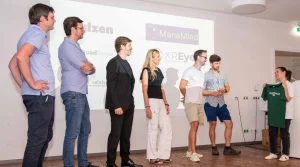
Meanwhile, the cohort launched in 2024 continued to demonstrate the long-term value of guided growth. Joulzen and RoadSense secured an additional year of support for their complex deep-tech development, CO2ol Catalyst extended by a further six months, while Manamind, CityLayers, and XREye successfully graduated — moving from potential to performance.
The results speak clearly. Across the i²ncubator and its alumni network in 2025, teams brought:
- 63 products to market,
- 497 jobs
- 31 awards and nominations
- €73.8 million of raised funds
These achievements were not isolated successes; they were the cumulative outcome of a structured system designed to guide scientific ideas through the uncertainty that precedes innovation. In essence, they demonstrate what happens when potential is not merely identified but continuously developed, challenged, and supported.
This is the philosophy behind investing in potential and celebrating performance. It reflects a belief that early-stage ideas deserve the same strategic attention as established companies, or even more. We need to ensure that sparks become engines of progress.
References:
[1] https://pmc.ncbi.nlm.nih.gov/articles/PMC11888142
[2] https://www.researchgate.net/publication/324067616_Knowledge_transfer_in_university-industry_research_partnerships_a_review
[3] https://www.sciencedirect.com/science/article/pii/S014829632400609X
Text: Ifigeneia Petrocheilou, Marketing & PR, i²c